
Large commercial facilities need flooring that can support a wide range of activities throughout the day. These spaces may include offices, retail areas, healthcare facilities, educational buildings, public service areas and other large environments where flooring needs to remain practical and easy to manage. Since these facilities often cover large floor areas, choosing a suitable flooring material can help provide a consistent and functional surface across different spaces.
Homogeneous vinyl sheet flooring is made as a full-thickness flooring material with the same composition throughout its structure. This construction provides a consistent surface from top to bottom and allows the pattern and colour to continue throughout the sheet. Its sheet format also helps create broad, continuous floor surfaces, making it a practical option for facilities that need one flooring solution across multiple areas.
In this article, we will explain how homogeneous vinyl flooring can support the flooring needs of large commercial facilities. We will also explore its continuous sheet installation, suitability for moisture-prone areas, routine cleaning, chemical resistance, use across different commercial areas, support for rolling loads, suitability for high-use spaces, design flexibility and practical maintenance.
Large facilities often need flooring that can cover wide areas without creating unnecessary breaks in the surface. Homogeneous vinyl sheet flooring is supplied in sheet form, allowing installers to create a continuous surface across large spaces.
The sheets can be installed with properly prepared and heat-welded seams. Heat welding joins the edges of the sheets together and creates a sealed connection between adjacent sections. This method helps provide a more continuous floor surface than installations that use many separate pieces.
A continuous sheet installation can also create a clean and organized appearance. This is useful in commercial environments where large floor areas need to look consistent while remaining practical for everyday use.
Moisture can be an important flooring consideration in many commercial facilities. These areas may experience water exposure during routine activities, cleaning or accidental spills, so the flooring material needs to perform well where moisture may be present.
Homogeneous vinyl flooring has a non-porous surface, which means liquids do not readily pass through the flooring material. When the installation is properly prepared and the seams are correctly heat welded, the continuous sheet system can provide a useful surface for areas where moisture resistance is required. This characteristic makes homogeneous sheet vinyl flooring suitable for selected commercial spaces where managing moisture exposure is part of the flooring requirement. It also provides facility managers with a practical surface that can be cleaned after liquid spills without relying on a porous flooring structure.
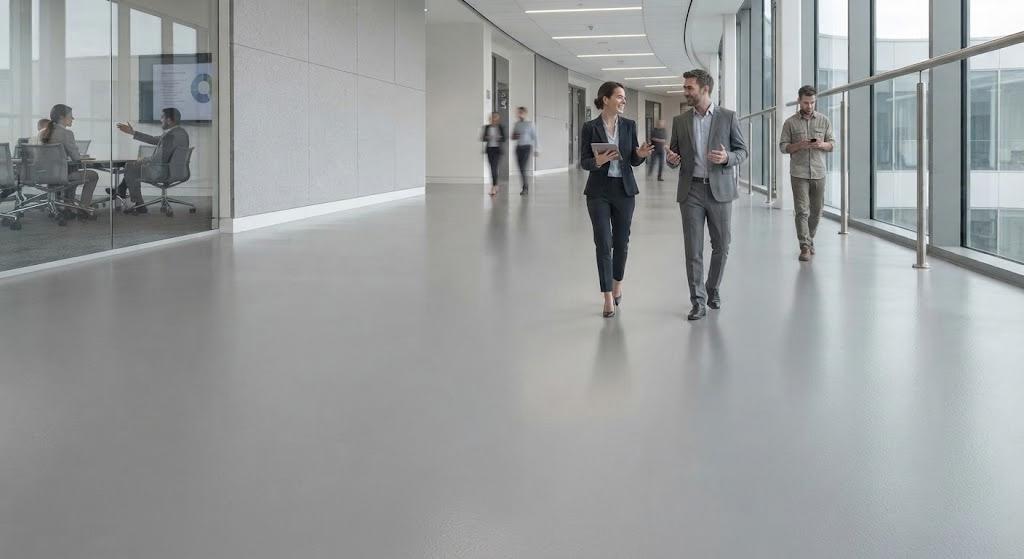
Large commercial facilities can have extensive floor areas that require regular cleaning. Choosing a flooring material that can be cleaned efficiently can make routine facility management more practical.
The smooth, sealed surface of homogeneous vinyl sheet flooring supports regular cleaning by providing a surface where dirt and spills can be removed without the deep absorption associated with porous materials. This can be useful in facilities that follow structured cleaning routines throughout the day.
Regular cleaning also helps maintain the appearance of the flooring. When suitable cleaning methods and products are used according to the flooring manufacturer’s guidance, the surface can remain neat and presentable while supporting the everyday needs of a busy commercial environment.
Commercial facilities may use a range of cleaning agents, disinfectants and other chemical products during routine operations. Flooring should therefore be selected based on the types of substances it may encounter.
Homogeneous vinyl flooring can provide resistance to various chemicals and disinfectants, depending on the specific product specification. This property can be valuable in areas where cleaning products are used regularly and accidental contact with chemicals may occur.
Selecting a flooring product with suitable chemical resistance can help facility planners choose a floor that matches the conditions of the intended space. The exact level of resistance should always be checked against the manufacturer’s technical information and the chemicals expected to be used within the facility.
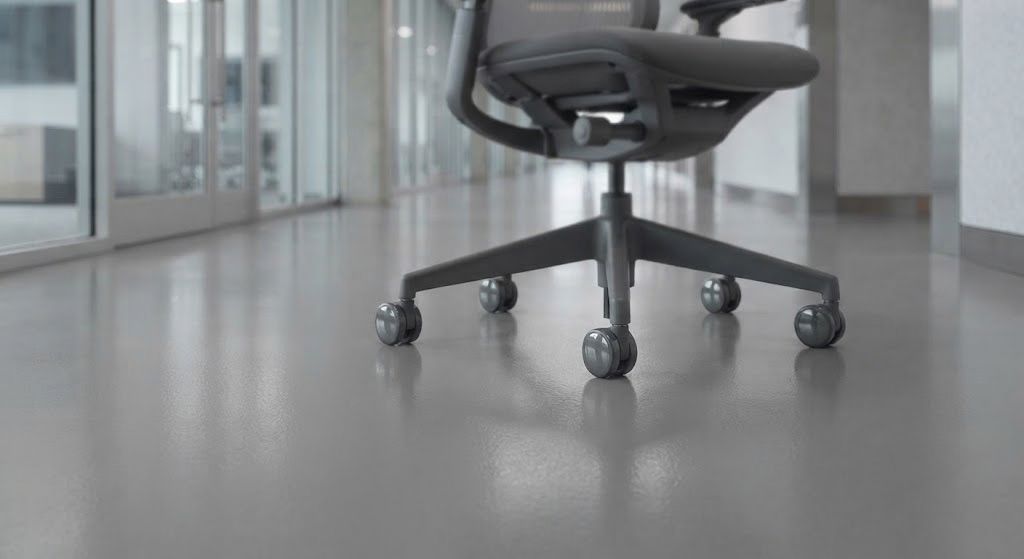
Large commercial facilities may have areas where wheeled equipment, carts or movable furniture are used regularly. Flooring in these spaces needs to provide a stable surface that can support repeated movement while remaining practical for everyday operations.
Homogeneous sheet vinyl flooring can be suitable for areas where rolling loads are part of normal activity. Its solid construction provides a stable flooring surface, while the sheet format creates a continuous area for movement. The suitability of a specific product should be confirmed based on its specified load and performance ratings.
This makes load requirements an important part of flooring selection. By matching the flooring specification with the type and frequency of rolling loads expected in each area, facility planners can choose a solution that better supports daily movement.
Large commercial facilities rarely have identical requirements in every area. An office section may have different needs from a retail space, while a healthcare or public service area may require additional surface characteristics.
Homogeneous vinyl sheet flooring can be considered for a range of commercial environments because its construction provides several useful properties within one flooring system. It can be used in areas where cleanliness, moisture resistance, surface consistency and routine maintenance are important considerations. This flexibility allows flooring planners to assess the needs of individual areas while considering a consistent flooring material across suitable sections of a facility. The final selection should still be based on the performance requirements, installation conditions and manufacturer’s recommendations for each application.
Some sections of large commercial facilities experience frequent daily use. People may move between rooms, work areas and shared spaces throughout operating hours, creating a need for flooring that can support regular activity.
Homogeneous vinyl can provide a practical surface for such environments because its material is consistent throughout the sheet. The flooring can be selected in suitable thicknesses based on the requirements of the application, with 3–4 mm options commonly used for demanding commercial environments. Selecting the right thickness and product specification can help match the flooring to the expected level of use. Instead of selecting flooring based only on appearance, facility planners can consider factors such as usage, movement, load requirements and the conditions of each area.
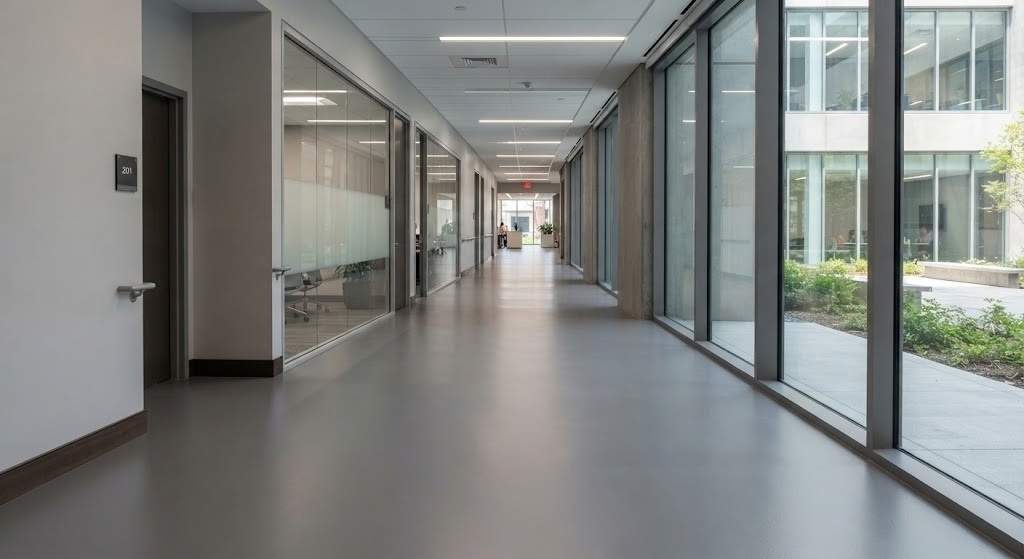
Large facilities often need flooring that works across several areas while allowing each section to have its own visual character. Flooring can support clear space planning through suitable colours, patterns or combinations within a consistent material category.
Homogeneous vinyl sheet flooring is available in a range of design options, allowing planners to choose appearances that suit different commercial settings. Colour choices can also help distinguish specific zones without requiring a completely different flooring type for every area.
This design flexibility can make it easier to create a coordinated flooring scheme across a large facility. By selecting complementary options, different areas can have a clear visual identity while maintaining a professional overall appearance.
Maintaining extensive floor areas requires a flooring solution that fits well into regular facility management routines. When a building contains large amounts of flooring, cleaning activities need to be practical, consistent and suitable for the surface.
Homogeneous vinyl has a smooth, sealed surface that supports routine cleaning. Its sheet construction can also reduce the number of individual floor pieces compared with flooring systems made from many separate tiles. Properly heat-welded seams further support a continuous surface that can be managed through established cleaning procedures. For facility managers, this can make maintenance planning more straightforward. A suitable cleaning schedule, correct cleaning products and manufacturer-recommended procedures can help keep the flooring clean and presentable while supporting the everyday operation of large commercial spaces.
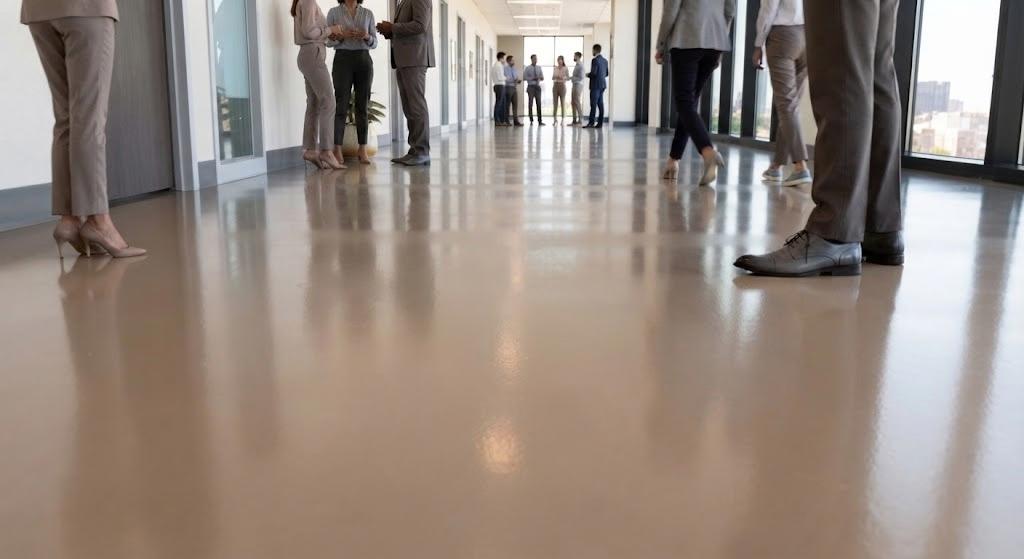
Homogeneous vinyl flooring can support the flooring needs of large commercial facilities by combining several practical qualities in one flooring solution. Its full-thickness construction, continuous sheet format, smooth surface, moisture resistance, chemical resistance and suitability for regular commercial use can help meet the different requirements found across large facilities. Its range of design options also allows suitable areas to maintain a coordinated and professional appearance.
By assessing the specific needs of each space, facility planners can select the appropriate flooring specification for areas with different levels of activity, moisture exposure, cleaning requirements and load conditions. With suitable product selection, proper installation and recommended maintenance, homogeneous sheet vinyl flooring can provide a practical and well-suited surface for large commercial environments.
Longda Flooring is the largest homogeneous flooring manufactuer in China. We are focus on commercial applications only, especially large areas. Homogeneous flooring is the best large commercial flooring.
Answer: Homogeneous vinyl flooring can be a suitable choice for large commercial facilities because it combines several useful properties in one flooring material. Its full-thickness construction provides consistent material throughout the sheet, while its smooth and non-porous surface supports routine cleaning and moisture management. The sheet format can also create broad, continuous floor areas when seams are properly heat welded. Suitable products can provide chemical and disinfectant resistance, support rolling loads and offer different performance specifications for various applications. These characteristics can help facility planners meet several flooring requirements across suitable commercial areas. The final choice should always consider the facility’s conditions and the manufacturer’s product specifications.
Answer: Yes, homogeneous vinyl sheet flooring can be used in different commercial areas when the selected product meets the requirements of each space. Large facilities may contain offices, retail areas, healthcare environments, educational buildings and public service spaces, each with different flooring needs. Some areas may require specific moisture resistance, slip resistance, chemical resistance, acoustic performance or load-handling capabilities. Different product specifications allow planners to select suitable options for specific applications. Its consistent construction and range of designs can also support a coordinated flooring approach across suitable areas. Each application should still be assessed to confirm that the selected product meets its performance and installation requirements.
Answer: Homogeneous vinyl sheet flooring can make routine maintenance more practical because its smooth, sealed and non-porous surface allows common dirt, dust and spills to be managed through suitable cleaning procedures. This can be useful in large facilities where extensive floor areas require regular cleaning. Its sheet format can also reduce the number of individual pieces compared with flooring systems made from separate tiles, while properly heat-welded seams help create a continuous surface. Facility managers should follow the manufacturer’s recommended cleaning methods and products to maintain the flooring properly. A suitable maintenance routine can help keep the surface clean and presentable during everyday facility operations.
Answer: Homogeneous vinyl flooring can provide useful resistance to moisture and various chemicals, depending on the specific product specification. Its non-porous surface limits liquid absorption, which can be beneficial in areas where spills or moisture exposure may occur. Correct installation and properly heat-welded seams can also create a continuous floor surface. Some products are designed to resist specific cleaning agents, disinfectants and chemicals. However, chemical resistance varies between products, so the manufacturer’s technical information should always be checked before selecting the flooring. This helps ensure that the flooring is suitable for the substances and conditions expected in the facility.
Answer: Facility planners should consider several factors before choosing homogeneous vinyl sheet flooring because flooring requirements can vary between commercial areas. These factors may include expected pedestrian and rolling loads, moisture exposure, chemical contact, slip resistance, acoustic requirements, dimensional stability and the required product thickness or performance classification. The subfloor should also be properly assessed and prepared before installation. Reviewing the manufacturer’s technical information helps confirm that the selected product meets the requirements of the intended application. Correct installation, including suitable adhesive selection and seam treatment, is also essential for achieving the expected flooring performance.
Copy right by Longda China