
Classrooms need flooring that supports daily learning while providing a safe and comfortable environment for students and teachers. Educational floors experience constant foot traffic, moving furniture, accidental spills and frequent cleaning. These conditions can lead to different flooring risks when the surface is not durable, easy to maintain and suitable for busy learning spaces. Homogeneous vinyl flooring has a uniform composition throughout its thickness, giving it reliable performance characteristics for demanding educational environments.
Homogeneous vinyl sheet flooring is especially suitable for classrooms because students move around frequently, carry school supplies and interact with furniture and equipment throughout the day. The right flooring surface can help reduce concerns related to slips, surface wear, hygiene and maintenance. When properly selected and installed according to the manufacturer’s requirements, homogeneous vinyl flooring can provide a practical and reliable flooring solution for busy educational environments.
In this article, we will explain how homogeneous vinyl flooring can help address common classroom flooring risks. We will also cover its role in reducing slip-related concerns, handling heavy classroom traffic, supporting hygiene, simplifying maintenance, managing surface damage and creating a more reliable learning environment.
Students and teachers are constantly moving around classrooms. Children may walk between desks, approach the board, collect learning materials or move toward classroom entrances. These frequent movements make it important to have a flooring surface with suitable slip resistance for normal classroom activities.
Homogeneous vinyl flooring can be manufactured with surface characteristics that provide an appropriate level of traction. When the flooring is properly selected for its intended environment, it can provide a more secure walking surface during everyday classroom activities. This can be particularly useful in areas where students frequently move between different parts of the room.
Spills can also occur during classroom activities. Water, drinks, art materials and other liquids may accidentally reach the floor. Prompt cleaning remains essential, but a flooring system that is easy to clean and offers suitable slip performance can help reduce risks during temporary wet conditions.
Classrooms experience continuous foot traffic throughout the school day. Students enter and leave the room, teachers move between different work areas and furniture may be repositioned regularly. Over time, these activities can place considerable stress on the flooring surface.
Homogeneous vinyl flooring has a consistent composition throughout its entire thickness. Its performance does not depend on a separate decorative wear layer in the same way as some multi-layer flooring products. As the surface experiences repeated wear, its uniform construction can help maintain consistent performance and appearance throughout its service life.
This characteristic can be valuable in educational facilities where flooring needs to remain functional for many years. Selecting a suitable commercial-grade product with appropriate wear resistance and performance characteristics can help reduce premature replacement caused by regular classroom traffic.
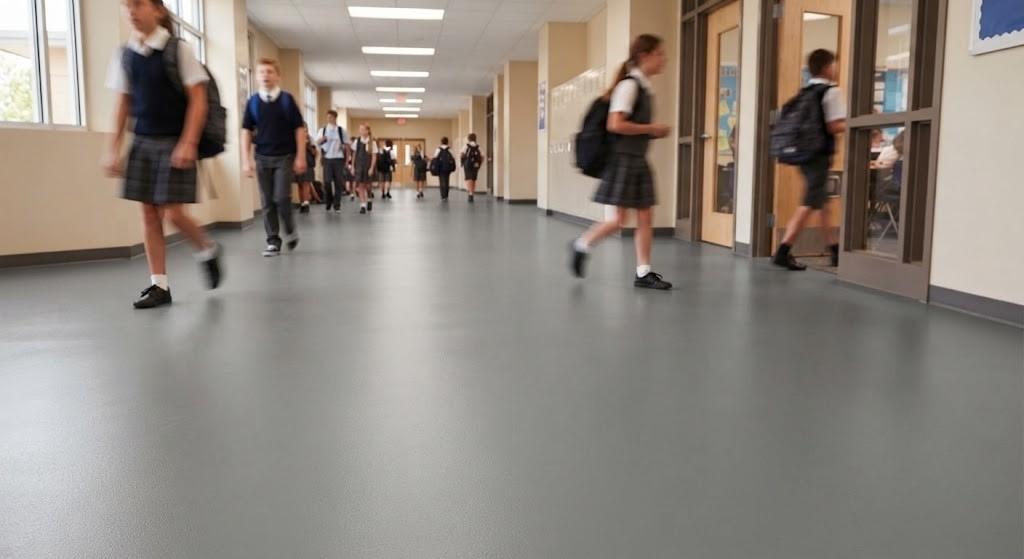
Classroom floors can collect dust, dirt and particles brought in through regular student movement. These materials can spread across the floor and may be harder to manage when the flooring has deep textures, open joints or areas that are difficult to clean.
Homogeneous vinyl can provide a smooth and sealed surface that is relatively easy to clean when properly installed and maintained. Regular cleaning can remove common dirt and contaminants before they build up. This makes the flooring suitable for educational environments where routine hygiene is an important part of facility management. Proper installation also plays an important role in maintaining hygiene. Correctly treated seams and edges can help create a more continuous floor surface and reduce areas where dirt may collect. A suitable maintenance program should always follow the flooring manufacturer’s recommendations.
Classrooms can become noisy when students walk across the floor, move chairs or take part in group activities. Excessive impact noise can make communication more difficult and may distract students during lessons. Certain homogeneous vinyl flooring systems are available with acoustic properties that can help reduce sound transmission and improve the classroom acoustic environment.
Important considerations include:
Flooring should not be expected to control all classroom noise on its own. Walls, ceilings, furniture and room design also affect acoustics. However, selecting a flooring system with tested acoustic performance can contribute to a quieter environment and help reduce some of the noise created by everyday movement.
Modern classrooms are not always arranged around fixed rows of desks. Students may participate in group activities, move between learning stations and work in different areas of the room. This creates a more active environment where flooring needs to handle frequent movement.
Homogeneous vinyl sheet flooring can provide a durable and practical surface for changing classroom activities. Its resistance to everyday wear, easy cleaning requirements and consistent construction can support the demands of active educational spaces.
Common Classroom Flooring Risk | How Homogeneous Vinyl Flooring Can Help |
Frequent foot traffic | Provides a durable surface designed for demanding use |
Everyday scuffing | Supports resistance to regular surface wear |
Accidental spills | Offers a practical surface for prompt cleaning |
Dirt accumulation | Provides a relatively smooth surface for routine cleaning |
Furniture movement | Provides durable flooring when combined with suitable furniture protection |
Regular maintenance | Supports established commercial cleaning routines |
Uneven wear concerns | Uniform construction provides consistent material through its thickness |
Active classroom movement | Provides a practical surface for changing classroom layouts |
These qualities make homogeneous vinyl a practical option for classrooms where safety, durability, cleanliness and everyday use are important. However, its performance depends on choosing the right product, installing it correctly and using the maintenance methods recommended by the manufacturer.
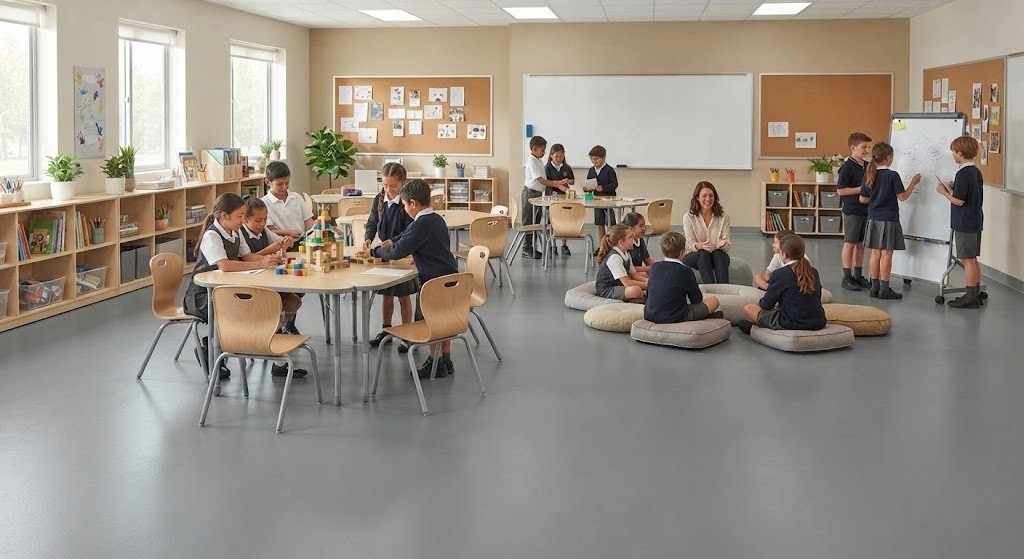
Spills are a common part of classroom activities. Students may accidentally drop drinks or spill liquids during educational tasks. If flooring absorbs liquids easily or is difficult to clean, small spills can become ongoing maintenance concerns.
A properly installed homogeneous vinyl floor provides a practical surface for routine spill cleanup. Its dense surface structure can make everyday cleaning easier, allowing staff to remove many common spills without complicated procedures.
Quick cleaning is still important. Spilled liquids should be cleaned as soon as possible to reduce slip risks and prevent dirt from sticking to the surface. Combining suitable flooring with proper cleaning practices can help maintain a safer and cleaner classroom environment.
Fire safety is an important consideration in educational buildings because classrooms contain furniture, teaching materials and electrical equipment. Flooring is one part of the building’s overall fire-safety strategy. Homogeneous vinyl flooring products can be tested for reaction-to-fire performance and may be available with classifications suitable for specific educational applications.
Key factors include:
Fire performance can vary between flooring products, so it should not be assumed simply because a floor is made from homogeneous vinyl. Facility managers should check the exact classification of the selected product and make sure it meets the requirements of the specific building. Correct product selection and installation allow the flooring to support the wider fire-safety strategy of the classroom.
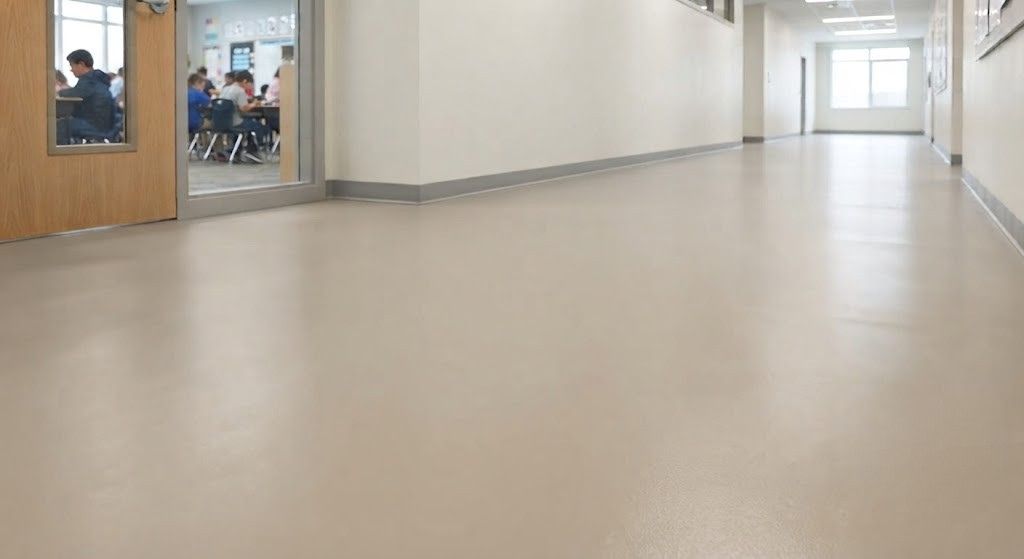
The materials used inside educational buildings can affect the indoor environment. Since classrooms are regularly occupied by students and teachers, flooring with documented low-emission performance can be an important consideration. Some homogeneous vinyl sheet flooring products are designed and tested to meet specific emission standards that can help limit the release of certain volatile organic compounds into indoor air.
When selecting flooring, facility teams should consider more than the floor covering itself. Adhesives, primers and other installation materials can also affect emissions. Choosing products with suitable emission certifications or test results can provide greater confidence in the overall flooring system.
Proper installation and ventilation are also important during and after installation. When the flooring system is installed according to the manufacturer’s requirements, its documented emission performance can support a better indoor environment. This makes low-emission characteristics an important factor when evaluating flooring for modern educational facilities.
Classrooms may come into contact with different substances during lessons and routine maintenance. Art materials, marking products and cleaning chemicals may occasionally spill onto the floor. If the flooring has limited resistance to a particular substance, it may become stained or damaged. Selecting homogeneous vinyl flooring with suitable chemical resistance can help reduce this risk.
The flooring should be evaluated based on the substances commonly used in the educational facility. Manufacturer testing and technical documentation can provide information about how a specific product performs when exposed to certain chemicals. Cleaning products should also be selected according to the flooring manufacturer’s recommendations.
Dealing with accidental spills quickly is also important. Unsuitable chemicals or highly concentrated cleaning products can damage flooring even when it has good general chemical resistance. Following recommended cleaning procedures and using approved products can help maintain the floor’s appearance and performance over time.
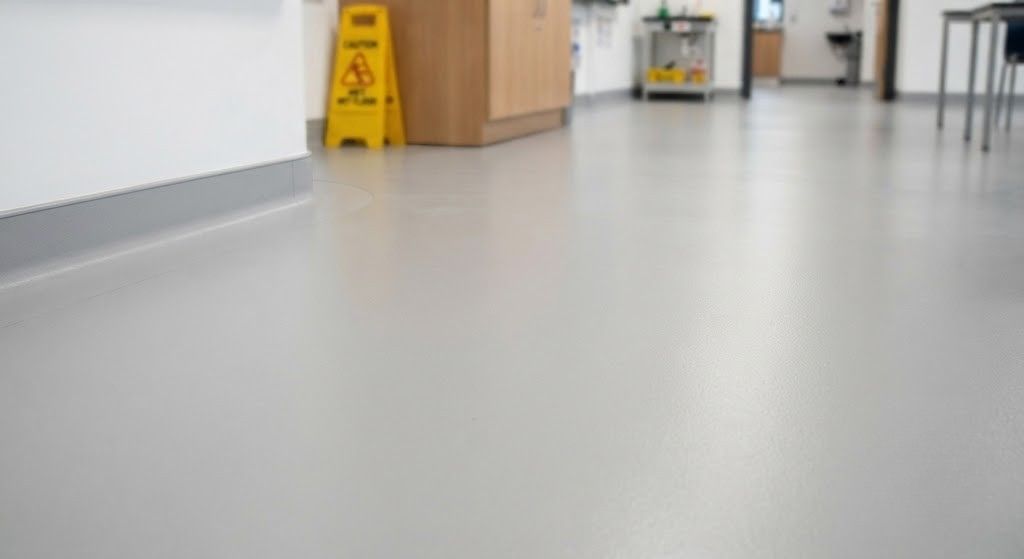
Homogeneous vinyl flooring can help reduce several common classroom flooring risks when the right product is selected, properly installed and maintained according to the manufacturer’s guidance. Its durable construction, consistent composition, easy cleaning and available performance options can support safer movement, better comfort, easier maintenance, acoustic control, indoor air quality considerations, fire-safety requirements and resistance to everyday substances. However, flooring alone cannot remove every classroom risk. Proper installation, regular maintenance and suitable safety practices remain essential for reliable long-term performance. By considering the specific needs of the educational environment, facility managers can select homogeneous vinyl sheet flooring that provides a practical, durable and suitable surface for busy learning spaces.
Longda Flooring is the largest homogeneous vinyl flooring manufacturer in China. School is our second largest applications. The flooring is safe, comfort, green and beautiful for school.
Answer: Yes, homogeneous sheet vinyl can be a suitable option for classrooms because it is designed for demanding environments where floors experience frequent foot traffic, regular cleaning and daily movement. Its uniform composition provides consistent material throughout its thickness, which can support long-term durability in busy educational spaces. Depending on the selected product, it may also offer tested properties related to slip resistance, acoustic performance, fire classification and chemical resistance. Performance can vary between products, so schools should always review the manufacturer’s technical specifications before choosing a flooring solution. When the right product is selected, properly installed and maintained according to the manufacturer’s instructions, homogeneous vinyl flooring can provide a practical and reliable surface for daily classroom activities.
Answer: Homogeneous vinyl flooring can help reduce several common classroom flooring risks by providing a durable, consistent and practical surface for regular use. Suitable products can offer tested slip-resistance properties that may help reduce slip-related concerns during everyday movement, while their durable construction can withstand repeated foot traffic and normal classroom activities. The flooring can also make spill cleanup easier and help maintain a consistent surface as it experiences regular wear. However, flooring cannot remove every safety risk on its own. Quick spill removal, suitable furniture protection, correct installation and regular maintenance are also necessary to maintain safe and reliable classroom conditions over time.
Answer: Homogeneous vinyl flooring can be relatively easy to clean and maintain when the correct maintenance procedures are followed. Its practical surface allows routine dust, dirt and common spills to be removed using suitable cleaning methods, helping facility teams maintain classroom cleanliness without complicated daily procedures. Regular maintenance can also help preserve the flooring’s appearance and performance throughout its service life. However, cleaning requirements can vary between products depending on their surface treatment and manufacturer specifications. Schools should therefore use recommended cleaning products, follow the correct cleaning methods and avoid unsuitable chemicals or excessive concentrations that could damage the flooring surface.
Answer: Homogeneous vinyl sheet flooring can contribute to classroom comfort and acoustic performance depending on the specific product and flooring system selected. Its resilient surface can provide a comfortable underfoot feel for students and teachers who spend long periods walking or standing in the classroom. Certain products may also offer acoustic properties that can help reduce impact noise from footsteps and everyday movement. However, acoustic performance depends on more than the floor covering. The subfloor, walls, ceiling and furniture can also affect sound transmission. Schools should therefore choose products with verified acoustic test results when noise control is an important requirement and consider the complete room design rather than relying on flooring alone.
Answer: Schools should consider several performance factors before choosing homogeneous vinyl flooring to ensure that the selected product suits the actual classroom environment. Important considerations include expected foot traffic, durability, slip resistance, cleaning requirements, acoustic performance, fire classification, chemical resistance, indoor air emission characteristics and compatibility with the existing subfloor. The installation method and maintenance program should also follow the manufacturer’s recommendations because these factors can directly affect long-term flooring performance. Schools should review reliable technical documentation and product test results rather than making decisions based only on the general properties of homogeneous vinyl sheet flooring. Careful product selection can help create a durable and practical classroom floor that supports everyday use while meeting the specific performance requirements of the educational facility.
Copy right by Longda China